
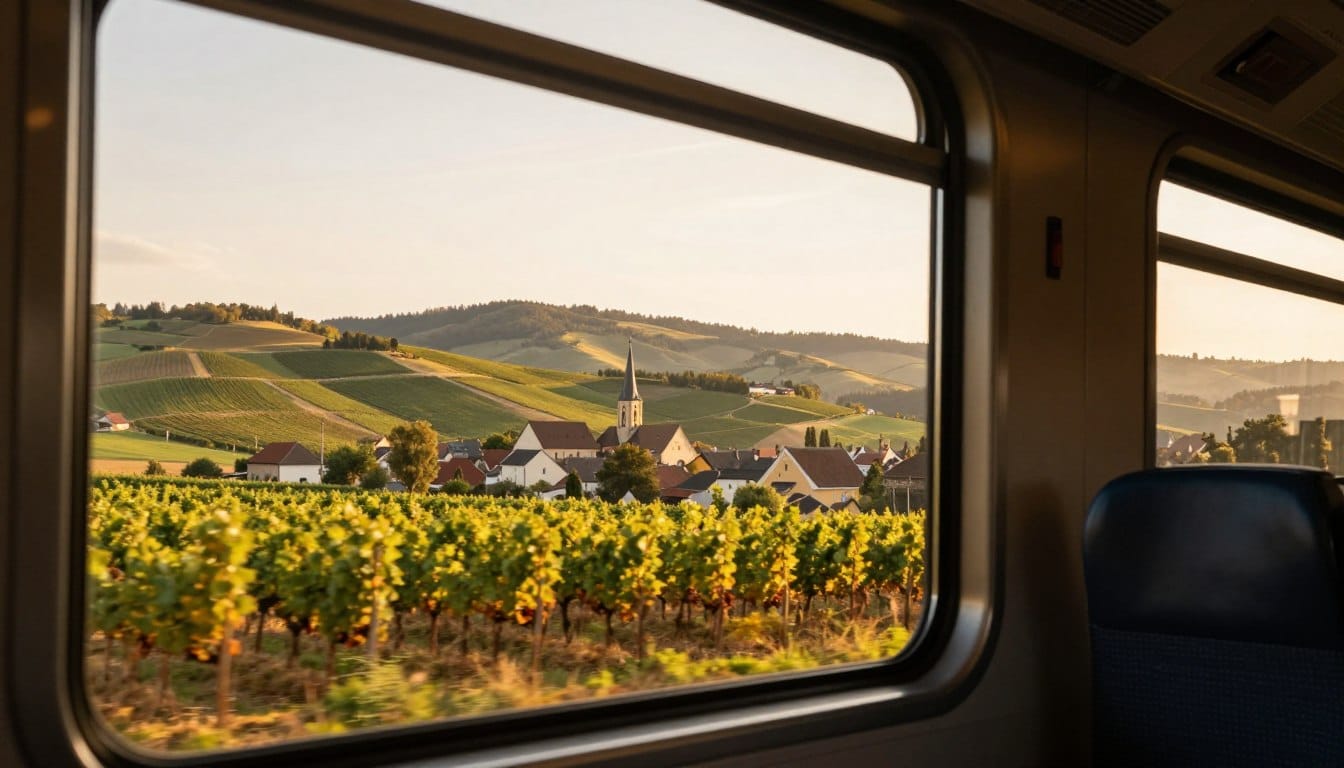
I remember my first European train journey vividly: watching the French countryside transform from the industrial outskirts of Paris to rolling vineyards, then rising dramatically into the snow-capped Alps. Villages appeared and disappeared like characters in a story, each with its own church spire, market square, and secrets. I wasn’t just traveling to somewhere; I was traveling through somewhere. And that made all the difference.
The unfolding landscape viewed from a European train window becomes part of the journey itself
Why Train Travel Changes the Way You See Europe
There’s something fundamentally different about arriving in a European city by train. You’re not deposited in a distant airport, disoriented and disconnected. Instead, you glide directly into the beating heart of the city, often through neighborhoods that tell the story of place—from industrial pasts to vibrant presents.
The Continuity of Place
When you fly, you experience Europe as a collection of disconnected dots on a map. Train travel in Europe reveals it as a continuous tapestry. You witness the gradual shifts in architecture as German precision gives way to Italian exuberance. You see how the light changes as you move from northern forests to Mediterranean shores. You understand, viscerally, how landscapes shape cultures and how borders are often arbitrary lines across continuous human stories.

Trains weave through landscapes that would otherwise remain unseen, revealing the true character of Europe
Train Stations vs. Airports
European train stations are cathedrals of transportation, often historic landmarks themselves. Unlike the clinical sameness of airports, each major station has its own character—from the Victorian grandeur of London’s St. Pancras to the soaring modern curves of Liège-Guillemins. They’re integrated into the urban fabric, places where locals and travelers naturally mix, rather than segregated non-places on the periphery.
Train stations welcome you with the immediate pulse of your destination. Step off at Gare du Nord in Paris, and you’re already surrounded by the sights, sounds, and smells of the city. No tedious transit from a distant airport—you’ve arrived, truly arrived, the moment you step onto the platform.

European train stations like this one are destinations in themselves, architectural marvels that tell stories of the past
Connected to Landscape and Culture
Train travel keeps you connected to the ground beneath you. You see how cities grow from their surroundings, how they’re shaped by rivers, mountains, and plains. You notice the farms that feed urban centers, the industrial zones that power them, the suburbs where people make their lives.
This connection extends to fellow travelers. On trains, you share space with locals going about their daily lives, students returning home, families on weekend trips. These fleeting encounters offer glimpses into authentic European life that no guided tour can provide. A grandmother sharing her homemade pastries with the carriage in southern Italy. Business colleagues debating politics over coffee in Germany. These moments become part of your travel story.
The great advantage of a train is that it takes us where we would never go. The train follows its own mysterious path, and we are swept along with it, seeing parts of countries we would never choose to see.
The Romance of Traveling by Train
There’s an inherent romance to train travel that other modes of transportation simply cannot match. It’s no coincidence that trains have featured prominently in literature and film as settings for intrigue, connection, and transformation. From Agatha Christie’s “Murder on the Orient Express” to Richard Linklater’s “Before Sunrise,” trains provide the perfect backdrop for life-changing encounters and revelations.
The Ritual of Departure
Train journeys have beginnings and endings that feel significant. The ritual of finding your platform, the anticipation as you wait for your train to arrive, the momentary confusion as you search for your carriage and seat—all build a sense of embarking on something meaningful. When the whistle blows and the train pulls away, there’s a palpable shift: the journey has begun.

The anticipation of departure is part of the romance of European train travel
The Cinematic Unfolding of Landscape
Train windows frame the world like cinema screens, presenting an ever-changing panorama. You might start a journey watching commuters on station platforms, then transition to industrial outskirts, suburbs giving way to farmland, villages, forests, mountains, and finally, the approach to your destination—the reverse sequence playing out as you arrive.
This cinematic quality creates natural space for reflection. As the landscape flows by, your thoughts can wander and settle. Problems that seemed insurmountable at home find perspective against the backdrop of ancient mountains or timeless seas. New ideas emerge in the gentle space between departure and arrival.

Train windows frame the world like cinema screens, creating space for reflection and wonder
The Gift of Time
In our rushed modern lives, train travel offers the increasingly rare luxury of unstructured time. Hours stretch before you without the constant demands of driving or the cramped discomfort of flying. This is time to read that novel you’ve been meaning to start, to write in your journal, to have an unhurried conversation, or simply to watch the world go by.
Some of my most treasured travel memories come from these in-between hours: sharing a bottle of wine with a stranger-turned-friend while crossing the Alps; reading a local author as their landscape unfolds outside my window; or simply watching the play of light across fields as the day slowly transitions to evening.

Train journeys offer the luxury of unstructured time for reading, conversation, and contemplation
Arriving in the Heart of Things
Perhaps the most romantic aspect of train travel in Europe is how it delivers you directly to the center of your destination. Step off the train in Venice, and you’re immediately surrounded by the watery magic of canals and centuries-old palazzos. Arrive in Prague, and the ancient city unfolds from the station door. There’s no lengthy transfer, no disorienting transition—just the immediate embrace of your destination.
This immediacy creates a sense of seamless integration into the places you visit. You arrive as travelers have for generations, following the same routes, seeing similar first impressions. You become part of the long human story of arrival and discovery, rather than bypassing it through the artificial environment of airports and highways.

Train stations deliver you directly to the heart of European cities, where the adventure begins immediately
Seeing Europe Slowly (What Changes When You Do)
Slow travel isn’t simply about reduced speed—it’s a philosophy that prioritizes depth over breadth, connection over consumption, and experience over checklists. Train travel in Europe naturally encourages this approach, rewarding those who embrace its rhythms with richer, more meaningful journeys.
Fewer Destinations, Deeper Experiences
When planning a train journey through Europe, you’ll quickly realize that covering six countries in seven days isn’t feasible—nor is it desirable. Instead, you might choose two or three carefully selected destinations, with the journeys between them becoming experiences in their own right.
This natural limitation becomes a gift. Rather than experiencing the blur of too many places too quickly, you can truly inhabit each destination. You have time to return to that perfect café you discovered, to wander without purpose, to develop a brief but genuine relationship with a place. You begin to see beneath the tourist veneer to the authentic rhythms and character of each location.

Slow travel allows time to savor local experiences rather than rushing between tourist attractions
More Rest, Less Transition Stress
One of the hidden costs of fast travel is the constant stress of transition—checking out, getting to airports, security lines, boarding, deplaning, finding transportation, checking in, orienting yourself, repeat. This cycle consumes enormous physical and emotional energy that could otherwise be invested in meaningful experiences.
Train travel reduces this transition stress dramatically. Stations are centrally located, security procedures are minimal, boarding is straightforward, and the journey itself offers rest rather than stress. You arrive refreshed rather than depleted, ready to engage with your destination rather than recover from reaching it.
The real voyage of discovery consists not in seeking new landscapes, but in having new eyes.
Greater Appreciation for Regional Differences
When you travel slowly by train, you begin to notice the subtle transitions between regions that would be invisible from 30,000 feet. The gradual change in architectural styles as you cross borders. The shift in what people are growing in their fields. The evolving palette of building materials reflecting local geology.
These observations foster a deeper understanding of why European cultures developed their distinct characteristics. You see how geography shapes cuisine, how climate influences lifestyle, how historical trade routes created connections between seemingly distant places. Europe transforms from a collection of stereotypes into a complex, interconnected tapestry of human adaptation and expression.

Train travel reveals the subtle transitions between European regions that would be invisible from above
Sustainable Connection to Place
Beyond the personal benefits, slow train travel fosters a more sustainable relationship with the places you visit. You’re not just consuming highlights and moving on; you’re participating in local economies, developing genuine appreciation for local cultures, and traveling in a way that minimizes environmental impact.
This approach creates a virtuous cycle. The more deeply you connect with places, the more you care about their preservation. The more mindfully you travel, the more welcome you are as a visitor. Slow travel by train isn’t just better for you—it’s better for Europe and its communities.

Train travel offers a more environmentally sustainable way to experience Europe’s beauty
Scenic & Soulful European Train Routes
While logistics and timetables have their place, the most memorable train journeys are those that move us emotionally as well as physically. Europe offers countless routes that transcend mere transportation, becoming experiences that remain with you long after you’ve returned home. Here are some of the most scenic train routes in Europe that promise not just views, but transformation.
The Majestic Alps: Switzerland’s Mountain Railways
Switzerland’s railways represent the pinnacle of engineering marvel married to natural splendor. The country’s mountain trains don’t simply pass through the Alps—they dance with them, curving around impossible bends, crossing vertiginous viaducts, and tunneling through ancient rock to emerge into valleys that seem plucked from dreams.
The Bernina Express connects the Swiss town of Chur with Tirano in Italy, crossing the Alps through some of Europe’s most dramatic landscapes. As the train climbs to the Bernina Pass at 2,253 meters, you’ll witness glaciers, alpine lakes, and meadows from panoramic windows specifically designed for sightseeing. The UNESCO World Heritage route includes the spectacular circular viaduct at Brusio, where the train loops back over itself to manage the steep gradient.

The Bernina Express crosses the Alps between Switzerland and Italy, offering some of Europe’s most spectacular mountain scenery
Equally magnificent is the Glacier Express, which connects the glamorous mountain resorts of St. Moritz and Zermatt on a seven-hour journey through 91 tunnels and over 291 bridges. Despite its name, this is one of the slowest express trains in the world—deliberately paced to allow passengers to absorb the majesty of the Oberalp Pass, the Rhine Gorge (Switzerland’s “Grand Canyon”), and the towering Matterhorn.
These journeys offer more than postcard views; they provide a profound sense of scale that puts human concerns in perspective. Watching ancient glaciers that carved these valleys over millennia, you can’t help but reflect on your own brief passage through this enduring landscape.

Panoramic carriages on Swiss mountain trains offer immersive views of the Alpine landscape
The Romantic Soul of Italy by Rail
Italian train journeys offer a different kind of magic—one that weaves together history, art, cuisine, and landscape into an experience that engages all the senses. The country’s extensive rail network connects its famous cities, but the most soulful journeys are often found on regional lines that reveal Italy’s diverse character.
The line connecting the five fishing villages of Cinque Terre hugs the rugged Ligurian coastline, offering breathtaking views of colorful towns seemingly suspended between mountain and sea. Tunnels carved through coastal cliffs suddenly open to reveal azure waters below and terraced vineyards above. The 20-minute journey between villages becomes a highlight rather than merely a connection.

The Cinque Terre railway offers spectacular views of colorful villages clinging to the Ligurian coastline
Further south, the journey from Naples to Sorrento on the Circumvesuviana railway offers views of the imposing Mount Vesuvius on one side and glimpses of the sparkling Bay of Naples on the other. This humble commuter line, with its open windows and local character, delivers travelers to the gateway of the Amalfi Coast and the ancient ruins of Pompeii and Herculaneum.
Perhaps most romantic of all is the slow train through Tuscany’s Val d’Orcia, where Renaissance landscapes unfold in gentle succession—cypress-lined roads leading to hilltop towns, undulating fields of wheat and sunflowers, and vineyards producing some of the world’s most celebrated wines. This journey feels like traveling through a living gallery of Italian landscape painting.

Regional trains through Tuscany reveal the timeless landscapes that have inspired artists for centuries
The Coastal Mediterranean: Where Mountains Meet the Sea
Some of Europe’s most spectacular train journeys occur where mountains meet the Mediterranean, creating dramatic coastal routes that have challenged engineers and delighted travelers for generations. These journeys combine the thrill of precarious passage with the serene beauty of the sea.
The line connecting Nice, France to Ventimiglia, Italy traces the glittering Côte d’Azur, offering tantalizing glimpses of exclusive beaches, yacht-filled harbors, and Belle Époque resorts. The train seems to cling to the edge of the continent, with the deep blue Mediterranean constantly visible on one side and the rising foothills of the Alps on the other.

The coastal railway between Nice and Ventimiglia offers continuous views of the azure Mediterranean
In Croatia, the railway connecting Split with Zagreb runs parallel to the Adriatic coast before turning inland through the dramatic Dinaric Alps. The contrast between the sun-drenched coastline with its island-dotted waters and the rugged mountain interior reveals Croatia’s dual character in a single journey.
These coastal routes remind us of humanity’s ancient relationship with the Mediterranean—a sea that has connected rather than divided cultures for millennia. As your train traces coastlines that have been traveled since antiquity, you become part of this continuing story of movement and exchange.

The railway along Croatia’s coast reveals the country’s stunning Adriatic shoreline and islands
Historic Routes: Journeys Through Time
Some European train journeys follow routes so steeped in history that they become passages through time as well as space. These historic lines connect major cultural centers, following ancient trade routes and carrying the echoes of travelers who came before.
The Paris to Venice overnight train revives part of the route of the legendary Orient Express, connecting two of Europe’s most romantic cities through the heart of the Alps. Falling asleep in France and waking up in Italy, with Switzerland and its mountains passing in the night, creates a magical sense of transportation that flying can never match.

Overnight trains like the Paris to Venice service offer the magical experience of falling asleep in one country and waking in another
The journey from London to Edinburgh along the East Coast Main Line follows the ancient route that has connected England and Scotland for centuries. Passing the medieval city of York with its magnificent Minster, the train continues north through Newcastle’s industrial heritage before hugging the dramatic Northumberland coast, with glimpses of ancient castles and the Holy Island of Lindisfarne.
These historic routes connect us not just to places but to the countless travelers who have made these journeys before—from merchants and migrants to artists and aristocrats. Their stories become part of your own as you follow in their tracks, seeing landscapes that have inspired and challenged generations.

The London to Edinburgh route passes historic castles and dramatic coastlines, connecting England and Scotland
How to Plan a Slow Train-Based European Trip
Planning a journey by train through Europe requires a different mindset than organizing a typical vacation. Rather than maximizing “sights seen per day,” you’re creating space for meaningful experiences and unexpected discoveries. Here’s how to approach planning for slow travel in Europe by train.
Choose Fewer Bases, Not More Destinations
The first principle of slow train travel is to resist the temptation to see “everything.” Instead of planning a whirlwind tour of European capitals, choose two or three strategic bases from which you can explore both cities and their surrounding regions. This approach reduces the number of times you need to change accommodations and creates a deeper connection with each place.
For example, rather than staying one night each in Vienna, Salzburg, and Innsbruck, consider basing yourself in Vienna for five nights. From there, you can take day trips by train to Salzburg (2.5 hours each way) and still have time to properly experience Vienna itself. This approach gives you the flexibility to follow your interests and energy levels each day.
Planning with fewer bases allows for deeper exploration and more relaxed travel rhythms
Stay Multiple Nights in Each Location
A cornerstone of slow travel is spending enough time in each place to move beyond the tourist experience. As a general rule, plan for a minimum of three nights in any location where you’re changing accommodation. This gives you at least two full days to explore—one for the “must-see” highlights and another for wandering, discovering, and following your curiosity.
Multiple-night stays also allow you to develop small rituals that connect you to local rhythms—finding “your” morning café, greeting the same shopkeepers each day, or watching the light change on a favorite building at different times. These repeated experiences often become more meaningful memories than checking another famous site off your list.
A good traveler has no fixed plans and is not intent on arriving.
Build Travel Days into the Experience
In slow train travel, the journeys between destinations aren’t lost time—they’re integral parts of the experience. When planning, treat travel days as experiences in themselves rather than merely transitions. Research the routes to identify particularly scenic sections where you’ll want to be alert and watching the landscape.
Consider breaking longer journeys with a lunch stop in an intermediate city. For example, when traveling from Paris to Barcelona by high-speed train, you might stop for a few hours in Perpignan to explore and enjoy a meal before continuing. This approach turns a utilitarian journey into another opportunity for discovery.

Dining cars transform travel days into experiences to savor rather than endure
Pack Light, But Right
One of the few challenges of train travel in Europe is managing your luggage. Unlike road trips where your car serves as a mobile storage unit, on trains you need to carry everything you bring. European train stations often have stairs, and not all have escalators or elevators. Smaller regional stations may have limited facilities.
The solution is twofold: pack light enough that you can comfortably carry your luggage up a flight of stairs, and pack smart with clothing that can be layered and mixed for different conditions. A capsule wardrobe of coordinating pieces will serve you better than specialized outfits for every occasion.

Traveling light makes navigating stations and boarding trains much more enjoyable
Consider Rail Passes for Flexibility
For journeys involving multiple countries or frequent train travel, rail passes like Eurail (for non-European residents) or Interrail (for European residents) can offer both savings and flexibility. These passes allow you to hop on many regional and local trains without advance reservations, supporting the spontaneity that makes slow travel so rewarding.
Even with a rail pass, some high-speed and overnight trains require reservations and supplemental fees. However, the pass often reduces these costs significantly compared to buying individual tickets. Research the specific requirements for countries you’ll visit to determine if a pass makes sense for your journey.
Rail passes offer flexibility for spontaneous journeys and regional exploration
Leave Room for Serendipity
Perhaps the most important principle of slow train travel is building space in your itinerary for the unexpected. Don’t schedule every hour of every day. Allow time to follow recommendations from locals, to stay longer in places that captivate you, or to take an unplanned side trip when something catches your interest.
Some of the most memorable travel experiences come from these unplanned moments—the festival you stumbled upon in a small town, the local train you impulsively boarded to see where it went, the conversation with a fellow traveler that led to a hidden gem. By planning less, you often experience more.

Leaving room in your itinerary for unexpected discoveries often leads to the most memorable experiences
Who Train Travel Is Best For
While train travel in Europe can appeal to many types of travelers, it particularly resonates with certain temperaments and life stages. Understanding whether this style of travel aligns with your preferences and needs can help you decide if it’s right for your next European adventure.
Couples Seeking Connection
Train journeys create natural spaces for connection. Without the distractions of driving or the constraints of flying, couples find time for conversation, shared observation, and the small moments of discovery that strengthen bonds. Watching a sunset over Alpine peaks from your train window, sharing a bottle of local wine in the dining car, or simply reading side by side as the landscape unfolds—these become the quiet, meaningful experiences that many relationships thrive on.
The practical aspects of train travel also reduce common sources of travel tension. No arguments about navigation or parking, no stress about making tight flight connections, and the ability to move around rather than remain confined to adjacent seats all contribute to a more harmonious travel experience.

Train journeys create natural spaces for couples to connect and share experiences
Solo Travelers Finding Balance
For solo travelers, trains offer the perfect balance between solitude and social opportunity. You can enjoy your own company, read, write, or simply watch the world go by, yet still have natural opportunities for interaction with fellow travelers and locals when desired.
Train travel also provides a greater sense of security for many solo travelers. You’re neither isolated as you might be when driving alone, nor forced into the close proximity of unfamiliar seatmates as on planes. The public yet respectful environment of a train carriage offers both safety and personal space—a combination particularly valued by solo travelers.

Solo train travel offers the perfect balance between solitude and connection
Midlife Travelers Seeking Depth
For travelers in midlife and beyond, train journeys often align perfectly with evolving travel priorities. With youth’s urgent need to “see everything” replaced by a desire for more meaningful, comfortable experiences, the measured pace and civilized nature of train travel becomes increasingly appealing.
Physical comfort matters too. Trains offer space to move around, avoiding the cramped conditions of economy air travel. There’s no need to drive in unfamiliar territories or navigate foreign traffic rules. And the direct city-center arrivals eliminate the need for long transfers from distant airports—a particular benefit for those who prefer to minimize unnecessary physical strain while traveling.
For my part, I travel not to go anywhere, but to go. I travel for travel’s sake. The great affair is to move.
Those Seeking Presence Rather Than Pace
Perhaps most fundamentally, train travel appeals to those who value presence over pace—travelers who understand that the quality of experience matters more than the quantity of destinations checked off a list. If you find joy in watching the gradual changes in landscape, architecture, and culture; if you believe that the journey itself holds as much potential for meaning as the destination; if you prefer to engage deeply rather than skim surfaces—then European train travel may be your ideal mode of exploration.
This approach to travel isn’t about age or circumstance as much as temperament and values. It appeals to the contemplative traveler, the one who seeks not just to see Europe, but to feel it, understand it, and connect with it in ways that last long after the journey ends.

Train travel rewards those who value presence and connection over simply collecting destinations
The Journey Becomes the Destination
In our rush to arrive, we often forget that travel—at its most profound—is not about the destination at all. It’s about the transformation that occurs along the way. Train travel in Europe invites us to reclaim this deeper purpose of journey. To see not just with our eyes, but with our hearts. To move through the world at a pace that allows for genuine connection and reflection.
As the landscape flows past your window—from the sun-drenched olive groves of Provence to the mist-shrouded forests of Bavaria, from ancient villages perched on Italian hillsides to the grand boulevards of imperial capitals—you become part of Europe’s continuing story. You join the countless travelers who have crossed these lands before you, each seeing with different eyes, each changed in different ways by the journey.
Perhaps this is the true gift of train travel in Europe: not just the sights you see or the places you visit, but the space it creates for you to notice how you are being changed by the experience. How your perspective shifts as the miles pass. How your understanding deepens with each border crossed. How your heart expands to embrace the beautiful complexity of this ancient, ever-evolving continent.
So let the train carry you not just across Europe, but into a different way of seeing and being in the world. Let the rhythm of the rails remind you that life itself is a journey, not a destination. And when you return home, carry with you not just photographs and souvenirs, but the unhurried wisdom of the rails—the knowledge that sometimes the richest experiences come when we slow down enough to notice the world unfolding around us, one mile, one moment at a time.
Begin Your European Rail Journey
Ready to experience the romance and beauty of train travel in Europe? Start planning your own slow journey through this magnificent continent.