
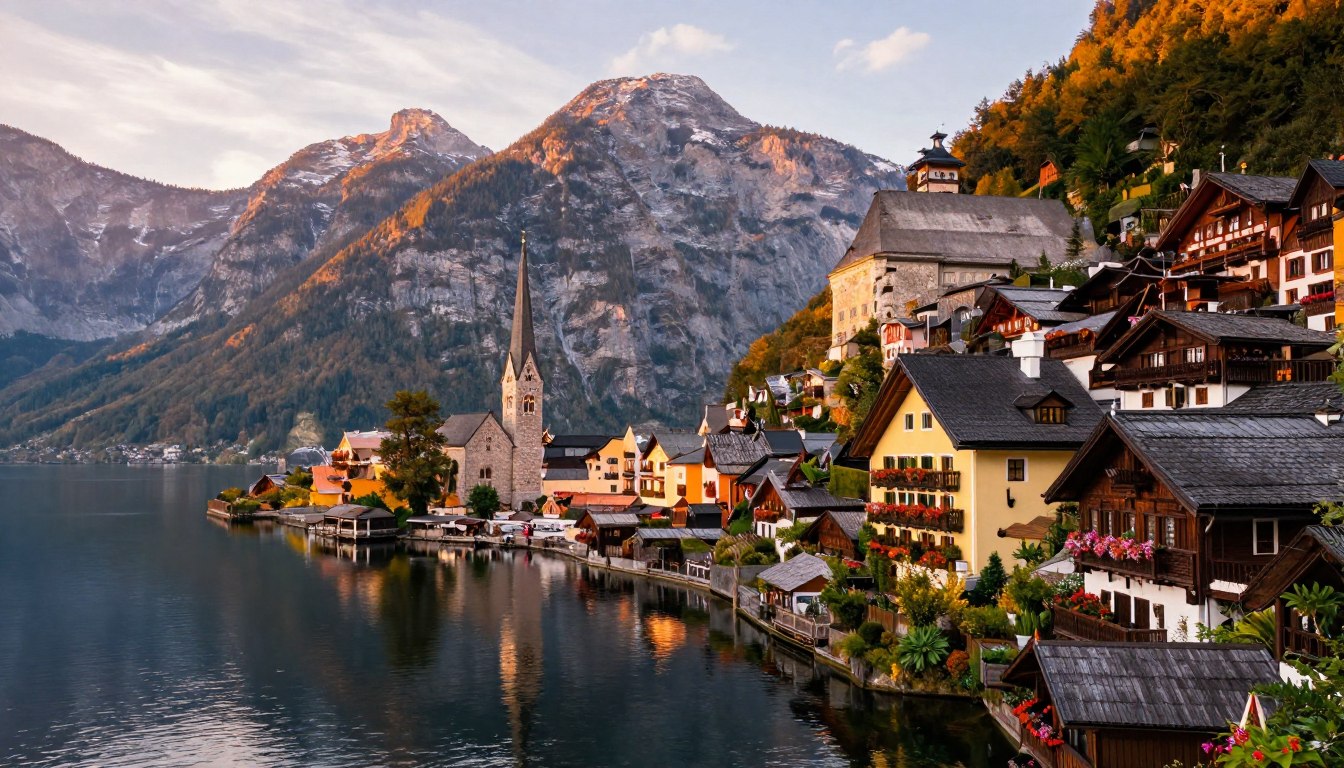
There’s something magical about wandering through a European town that seems frozen in time—where cobblestone streets wind between centuries-old buildings, where cafés spill onto sunlit squares, and where every corner feels like it could be the backdrop for a classic film. These aren’t just destinations; they’re portals to another era, places where the modern world fades away and you find yourself immersed in scenes worthy of cinema.
In this journey, we’ll explore ten of Europe’s most enchanting small towns that capture that perfect blend of architectural charm, walkable neighborhoods, and nostalgic atmosphere. From lakeside villages nestled in Alpine valleys to medieval hamlets perched on hilltops, these destinations offer more than just pretty pictures—they provide an experience that engages all your senses and leaves you feeling like the protagonist in your own European adventure.
1. Hallstatt, Austria: The Alpine Fairytale
Tucked between soaring Alps and the glassy waters of Lake Hallstatt, this Austrian gem seems almost too perfect to be real. Pastel-colored houses cling to the mountainside, their reflections dancing in the crystal-clear lake below. As you wander the narrow lanes of this UNESCO World Heritage site, the absence of cars creates a peaceful atmosphere that transports you to a simpler time. It’s no wonder that Hallstatt reportedly inspired the kingdom of Arendelle in Disney’s “Frozen”—the town exudes fairytale charm from every angle.
Don’t Miss:
- The Skywalk Hallstatt viewing platform, offering breathtaking panoramic views of the town and surrounding mountains
- A traditional wooden boat ride on Lake Hallstatt for the most photogenic views of the village
- The ancient salt mines that gave the town its prosperity, accessible via a funicular railway
Ideal Season to Visit:
Late spring (May-June) offers the perfect balance of pleasant temperatures, blooming flowers cascading from balconies, and fewer tourists than the summer high season. Winter transforms Hallstatt into a snow-covered wonderland, though many attractions have limited hours.
2. Colmar, France: The Colorful Alsatian Dream

Strolling through Colmar feels like walking through the pages of a storybook. This Alsatian town boasts a kaleidoscope of half-timbered houses painted in cheerful pastels, creating a whimsical backdrop that seems designed for a Wes Anderson film. The “Little Venice” quarter, where the Lauch River winds through town, offers postcard-perfect scenes at every turn. Flower boxes overflow with blooms, adding splashes of color to the already vibrant streetscape, while the blend of French and German influences creates a cultural richness that extends from the architecture to the cuisine.
Don’t Miss:
- The Unterlinden Museum, housed in a 13th-century Dominican convent, featuring the Isenheim Altarpiece
- A leisurely boat ride through Little Venice, gliding under bridges and past waterfront houses
- The Pfister House, a stunning example of Renaissance architecture with an ornate wooden gallery
Ideal Season to Visit:
Early fall (September-October) offers comfortable temperatures and golden light that enhances Colmar’s colorful facades. December transforms the town into a magical Christmas wonderland with markets that have been held since the Middle Ages.
3. Ronda, Spain: The Dramatic Clifftop Marvel

Perched dramatically atop a deep gorge in Spain’s Andalusia region, Ronda seems to defy gravity and logic. The town is split in two by the 100-meter-deep El Tajo gorge, with the spectacular 18th-century Puente Nuevo (New Bridge) connecting the old Moorish quarter with the newer parts of town. White-washed buildings cling to the cliff edges, creating a scene so cinematic it has inspired artists and writers for centuries, including Ernest Hemingway and Orson Welles. As you wander the cobblestone streets, you’ll discover quiet plazas where time seems to stand still and viewpoints that will leave you breathless.
Don’t Miss:
- The Plaza de Toros, Spain’s oldest bullring and a stunning example of 18th-century architecture
- The Arab Baths, remarkably preserved from the 13th century when the Moors ruled the region
- The viewpoint at the Mirador de Aldehuela for the most dramatic photos of the bridge and gorge
Ideal Season to Visit:
Spring (April-May) and fall (September-October) offer ideal temperatures for exploring, with fewer tourists than summer and beautiful wildflowers or autumn colors enhancing the dramatic landscape.
Packing for the Cobblestones: Essential Gear for European Town Exploration
After exploring the first three towns on our list, you’ve likely noticed a common theme: cobblestone streets and plenty of walking. While these historic pathways add immeasurable charm to Europe’s cozy towns, they can be challenging on your feet and back without the right gear. Here are two essentials that will make your European adventure more comfortable without sacrificing style:

Comfortable Walking Shoes
Those picturesque cobblestone streets in Hallstatt, Colmar, and Ronda may be beautiful, but they can be unforgiving on your feet. These lightweight, cushioned walking shoes offer the perfect blend of support and style. With memory foam insoles and durable, flexible outsoles, they’ll keep you comfortable through hours of exploration without looking like typical “tourist shoes.” The water-resistant exterior is perfect for unexpected European showers, while the classic design pairs easily with both casual and smart-casual outfits.

Anti-Theft Travel Daypack
Navigating through charming European towns requires a practical yet stylish bag to carry your essentials. This anti-theft daypack features hidden zippers and RFID-blocking pockets to keep your belongings secure while exploring bustling market squares. The lightweight, water-resistant design includes dedicated compartments for your water bottle, camera, guidebook, and personal items, all while maintaining a slim profile that won’t mark you as a tourist. The padded straps distribute weight evenly, preventing shoulder fatigue during those long days of wandering through medieval streets and discovering hidden viewpoints.
4. Český Krumlov, Czech Republic: The Bohemian Time Capsule

Nestled in a tight bend of the Vltava River, Český Krumlov is a Bohemian jewel that seems suspended in the Renaissance era. The town’s skyline is dominated by its magnificent 13th-century castle, whose tower rises above a sea of orange-red rooftops. As you wander through the perfectly preserved historic center, you’ll discover a labyrinth of winding cobblestone streets, artisan workshops, and hidden courtyards. The absence of modern architectural intrusions creates such an authentic medieval atmosphere that you half-expect to see knights and ladies appearing around corners. Český Krumlov’s compact size makes it perfect for exploring on foot, allowing you to soak in its timeless charm at a leisurely pace.
Don’t Miss:
- The elaborate Český Krumlov Castle complex with its unique Baroque theater, one of few preserved in Europe
- A traditional rafting trip down the Vltava River for a different perspective of the town
- The historic Eggenberg Brewery, producing beer since the 16th century
Ideal Season to Visit:
Late spring (May-June) or early fall (September) offer pleasant weather and fewer crowds than the peak summer months. The Five-Petalled Rose Festival in June transforms the town into a Renaissance celebration with costumed parades, medieval markets, and tournaments.
5. Rothenburg ob der Tauber, Germany: The Medieval Masterpiece

If you’ve ever imagined stepping into a Brothers Grimm fairy tale, Rothenburg ob der Tauber is that fantasy come to life. This immaculately preserved medieval town sits atop a plateau overlooking the Tauber River in Bavaria. Walking through its intact 13th-century walls feels like traveling back in time—colorful half-timbered houses line narrow cobblestone streets, their window boxes overflowing with geraniums. The town’s most photographed spot, Plönlein (“Little Square”), with its yellow half-timbered house at the intersection of two picturesque streets, is so quintessentially storybook that it inspired scenes in Disney’s “Pinocchio.” As evening falls and gas lamps illuminate the quiet streets, you’ll understand why Rothenburg has been a filming location for numerous period films.
Don’t Miss:
- The Medieval Crime Museum (Mittelalterliches Kriminalmuseum), showcasing fascinating (if somewhat disturbing) instruments of justice
- The Night Watchman’s Tour, a entertaining walking tour led by a guide in historical costume
- Walking the covered pathway atop the town walls for unique views of both the town and surrounding countryside
Ideal Season to Visit:
Early fall (September-October) offers comfortable temperatures and fewer crowds. December transforms Rothenburg into a Christmas wonderland with its famous Reiterlesmarkt (Christmas Market), though this is also the busiest season.
6. Bruges, Belgium: The Medieval Canal City

Often called the “Venice of the North,” Bruges captivates visitors with its network of canals winding through a perfectly preserved medieval center. The reflections of step-gabled buildings in the still waters create scenes so picturesque they seem almost staged. Horse-drawn carriages clip-clop across cobblestone squares, while swans glide serenely beneath arched stone bridges. The compact historic center, a UNESCO World Heritage site, feels like an open-air museum where Gothic architecture and Flemish art masterpieces abound. Bruges’ timeless beauty has made it a favorite filming location, most notably in the dark comedy “In Bruges,” but the real magic is experiencing the town after day-trippers leave, when quiet evenings transform the lamp-lit streets into something truly enchanting.
Don’t Miss:
- The view from the 83-meter Belfry tower in the Market Square (Markt), offering panoramic vistas of the city
- A boat tour of the canals for a unique perspective of the medieval architecture
- The Groeningemuseum, housing an impressive collection of Flemish primitive paintings
Ideal Season to Visit:
Spring (April-May) brings mild weather and fewer tourists, with beautiful flowers blooming throughout the city. Winter offers a magical atmosphere with Christmas markets and occasionally, if you’re lucky, snow-dusted medieval rooftops.
Essentials for Your European Getaway: Packing Smart for Changing Seasons
As we’ve seen with towns like Rothenburg and Bruges, European weather can be unpredictable, and the best visiting seasons often fall in transitional months like spring and fall. Packing the right gear is essential for enjoying these charming destinations in comfort, regardless of what the weather brings:

Versatile Travel Jacket
When exploring medieval towns like Bruges or Rothenburg, weather can change quickly as you move between sunny squares and shaded narrow streets. This lightweight, packable jacket is perfect for layering and adapts to changing conditions. With a water-resistant exterior that repels light rain and wind, it’s ideal for those unexpected European showers. The thoughtful design includes hidden interior pockets for securing valuables while exploring busy market squares, and the classic styling ensures you’ll look like a sophisticated traveler rather than a tourist. When not needed, it compresses into its own pocket, taking minimal space in your daypack.

European-Friendly Carry-On Luggage
Navigating train stations and cobblestone streets between picturesque towns requires luggage that’s both durable and maneuverable. This carry-on suitcase features multi-directional spinner wheels that glide smoothly over uneven surfaces, while meeting European airline size restrictions. The expandable design offers flexibility for those inevitable souvenirs, and the hardshell exterior protects your belongings while remaining lightweight. Inside, thoughtful organization features keep your clothes wrinkle-free and your accessories easily accessible. The telescoping handle adjusts to different heights for comfortable rolling whether you’re rushing to catch a train in Bruges or navigating the narrow streets of Český Krumlov.
7. Sintra, Portugal: The Romantic Mountaintop Retreat

Perched among the pine-covered hills of the Portuguese Riviera, Sintra feels like it was conjured from the imagination of a romantic poet—which is perhaps why Lord Byron called it a “glorious Eden.” This UNESCO World Heritage site is a treasure trove of fantastical architecture, where colorful palaces emerge from misty forests and exotic gardens cascade down mountainsides. The town center, with its quaint cafés and traditional Portuguese tiles, offers a charming base, but it’s the surrounding hills that hold Sintra’s most cinematic wonders. Each palace and villa seems to compete for the title of most whimsical, creating an atmosphere that blends fairytale wonder with romantic mystery.
Don’t Miss:
- The technicolor Pena Palace, a Romanticist castle with vibrant yellow and red towers visible for miles around
- Quinta da Regaleira, with its enigmatic gardens featuring underground tunnels, grottoes, and the famous Initiation Well
- The ancient Moorish Castle, offering panoramic views across the Serra de Sintra mountains to the Atlantic Ocean
Ideal Season to Visit:
Spring (April-May) and fall (September-October) offer pleasant temperatures and fewer crowds. The misty mornings common in spring add an ethereal quality to the already magical landscape.
8. Èze, France: The Eagle’s Nest of the Côte d’Azur

Clinging to a rocky peak 1,400 feet above the Mediterranean, the medieval village of Èze seems to defy gravity. This “eagle’s nest” village on the French Riviera offers a dramatic contrast to the glamorous beaches below—here, time appears to have stopped centuries ago. Narrow cobblestone pathways wind between ancient stone houses, opening occasionally to reveal breathtaking panoramic views of the azure coastline stretching toward Monaco and Italy. The village is so vertical that it feels more like a living sculpture than a town, with buildings stacked upon one another and secret passageways revealing hidden gardens and artisan workshops. As you climb to the top, the Exotic Garden offers not only spectacular views but also a sense of having ascended to a place between earth and sky.
Don’t Miss:
- The Jardin Exotique (Exotic Garden) at the village’s peak, with its collection of cacti and succulents set against panoramic Mediterranean views
- The medieval Chapelle de la Sainte Croix, dating back to the 14th century
- The traditional perfumeries, where you can create your own signature scent as a unique souvenir
Ideal Season to Visit:
Late spring (May-June) or early fall (September) offers ideal temperatures and clear skies for appreciating the spectacular views. Summer brings crowds and heat, though evening visits can be magical as the lights of the coastline twinkle below.
9. Alberobello, Italy: The Trulli Wonderland

Walking into Alberobello’s Rione Monti district feels like entering a fantasy world—hundreds of curious, conical-roofed houses create a landscape unlike anywhere else in Europe. These traditional Puglian structures, known as trulli, date back to the 14th century and are built without mortar, their limestone walls whitewashed and their stone roofs often decorated with primitive symbols. The result is a surreal, almost fairytale-like townscape that seems designed for a film set. The trulli are concentrated in two districts, creating neighborhoods where you can wander through narrow lanes, peek into trulli-shops selling local crafts, or even stay overnight in a converted trullo home. Despite its popularity, Alberobello maintains an authentic charm, especially in the early morning or evening when day-trippers have departed.
Don’t Miss:
- Trullo Sovrano, the only two-story trullo, now operating as a museum showcasing traditional furnishings
- The Church of Saint Anthony, uniquely built in the trullo style with a trullo dome
- The less-touristed Aia Piccola district, where many trulli are still residential homes
Ideal Season to Visit:
Late spring (May-June) or early fall (September-October) offers pleasant temperatures and fewer crowds. The brilliant white of the trulli against clear blue skies makes for stunning photography during these seasons.
10. Bibury, England: The Quintessential Cotswold Gem

Described by William Morris as “the most beautiful village in England,” Bibury embodies the timeless charm of the Cotswolds. The village’s crown jewel is Arlington Row, a line of 14th-century weavers’ cottages built in honey-colored Cotswold stone, their steep roofs and leaded windows creating a scene so quintessentially English it appears on the inside of UK passports. The gentle River Coln winds through the village, its banks lined with wildflowers and crossed by old stone bridges. Surrounding meadows filled with grazing sheep complete the pastoral idyll. Despite its small size, Bibury packs an enormous visual punch, offering a concentrated dose of the architectural and natural beauty that makes the Cotswolds a favorite filming location for period dramas.
Don’t Miss:
- Arlington Row, the photogenic street of former weavers’ cottages now owned by the National Trust
- The Bibury Trout Farm, one of England’s oldest, where you can catch your own lunch
- St. Mary’s Church, with elements dating back to the Saxon era and beautiful stained glass
Ideal Season to Visit:
Late spring (May-June) brings lush greenery and flowers to the already picturesque setting. Fall offers golden light that perfectly complements the honey-colored stone buildings. Summer weekends bring crowds, so early mornings are best for photography.
Ready to Roam? Capture Your European Movie-Set Moments
After exploring these ten enchanting European towns, you’ll want to preserve your memories of cobblestone streets, medieval architecture, and picture-perfect vistas. The right equipment can help you capture those cinematic moments and keep them close long after your journey ends:

Premium Compact Travel Camera
While smartphone cameras have improved dramatically, the unique lighting and architectural details of places like Bibury’s Arlington Row or Alberobello’s trulli deserve to be captured with superior quality. This compact travel camera offers professional-level features in a pocket-sized package. With a large sensor for exceptional low-light performance (perfect for those moody evening shots in Rothenburg), a sharp wide-angle lens to capture narrow medieval streets, and intuitive manual controls for creative flexibility, it’s the ideal companion for documenting your European adventure. The camera’s discreet size won’t mark you as a tourist, while its rapid startup ensures you never miss those spontaneous, cinematic moments that make these towns so special.

European Adventure Journal
Some experiences can’t be fully captured in photographs alone. This beautifully crafted travel journal provides the perfect place to record your impressions of misty morning walks through Sintra’s gardens or the taste of fresh trout in Bibury. Featuring high-quality paper that accepts both ink and watercolor, pockets for ticket stubs and mementos, and elegant map inserts of European regions, it becomes a personalized keepsake of your journey. The journal’s compact size fits easily in your daypack, while its durable leather cover develops a beautiful patina as you travel, becoming a physical embodiment of your adventures. Years later, you’ll treasure these handwritten memories of café conversations, local recommendations, and those perfect cinematic moments that weren’t caught on camera.
Step Into Your Own European Story

These ten towns represent just a small sampling of Europe’s cinematic treasures. What makes them special isn’t just their architectural beauty or historical significance, but the way they transport us to another time and place—allowing us to step into scenes we might have only experienced through film. The real magic happens when you venture beyond the main attractions, perhaps getting lost in narrow side streets, finding a local café where you can watch daily life unfold, or staying overnight to experience these places after the day-trippers have departed.
Whether you’re drawn to the alpine splendor of Hallstatt, the colorful whimsy of Colmar, or the medieval perfection of Rothenburg, these destinations offer more than just photo opportunities—they provide immersive environments where you become part of the scene rather than merely an observer. Pack your comfortable shoes, bring your sense of wonder, and prepare to write yourself into the story of these remarkable European settings. The most memorable souvenirs won’t be the ones you can buy, but the moments when you feel like the protagonist in your own European adventure, walking through real-life movie sets that have been centuries in the making.